
If you are choosing between a solid wood and an MDF bathroom vanity, the short version is this: MDF costs less today and can look perfectly good on day one, while solid wood costs more up front and holds up far longer in a room full of water and steam. Which one is right depends on how long you want it to last and how the math works over the life of the piece. Here is what each one actually is, so you are comparing the same thing.
Solid wood vs. MDF at a glance
| Solid wood | MDF (medium-density fiberboard) | |
|---|---|---|
| What it is | Real boards of one species, joined into a cabinet | Wood fibers and resin pressed into panels |
| Water behavior | Moves slightly with humidity; sheds water when finished | Swells and crumbles if water reaches the core |
| Lifespan in a bathroom | Many years; repairable and refinishable | Depends on water exposure; edges and the sink cutout fail first once moisture reaches the core |
| Repairable | Yes, can be sanded and refinished | No, swollen board cannot be restored |
| Look | Real grain, knots, character | Smooth, uniform, usually painted |
| Up-front cost | Higher | Lower |
What MDF actually is
MDF is wood fibers and resin pressed under heat into a flat, uniform panel. It is dense, smooth, and takes paint beautifully, which is why so many budget vanities use it. For a piece that lives in a dry room, it can serve for years.
A bathroom is not a dry room. MDF’s weakness is its core: once water gets past the painted or laminated surface, usually at a cut edge, a corner, or around the sink cutout, the fibers absorb it and swell. A swollen MDF panel does not dry back to its original shape. It stays puffed, the paint cracks, and over time the material can crumble. This is the source of most “my wood vanity fell apart” stories. The vanity was rarely solid wood to begin with.
What solid wood actually is
Solid wood is real boards, milled from a single species and joined into a cabinet. It moves a little with the seasons, taking on a touch of moisture when the air is humid and releasing it when the air dries. A cabinet built to allow for that movement handles it without complaint, the way a wood floor or an old door does.
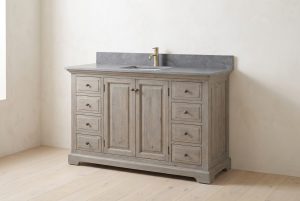
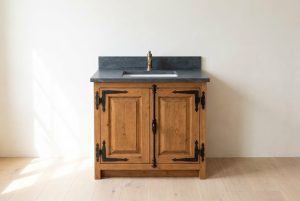
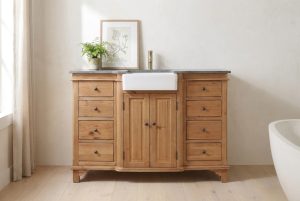
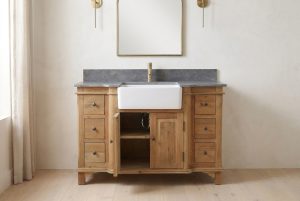
Our vanities are designed in High Point, NC and made to our specifications from solid pine with rustic character. Wood with this kind of age has already spent decades expanding and contracting, so it is unusually settled and stable by the time it becomes a vanity. You can read more about how we work in our story.
The part that decides everything: construction
Two vanities can both say “wood” and be built nothing alike. The joinery is what determines whether a piece survives a bathroom:
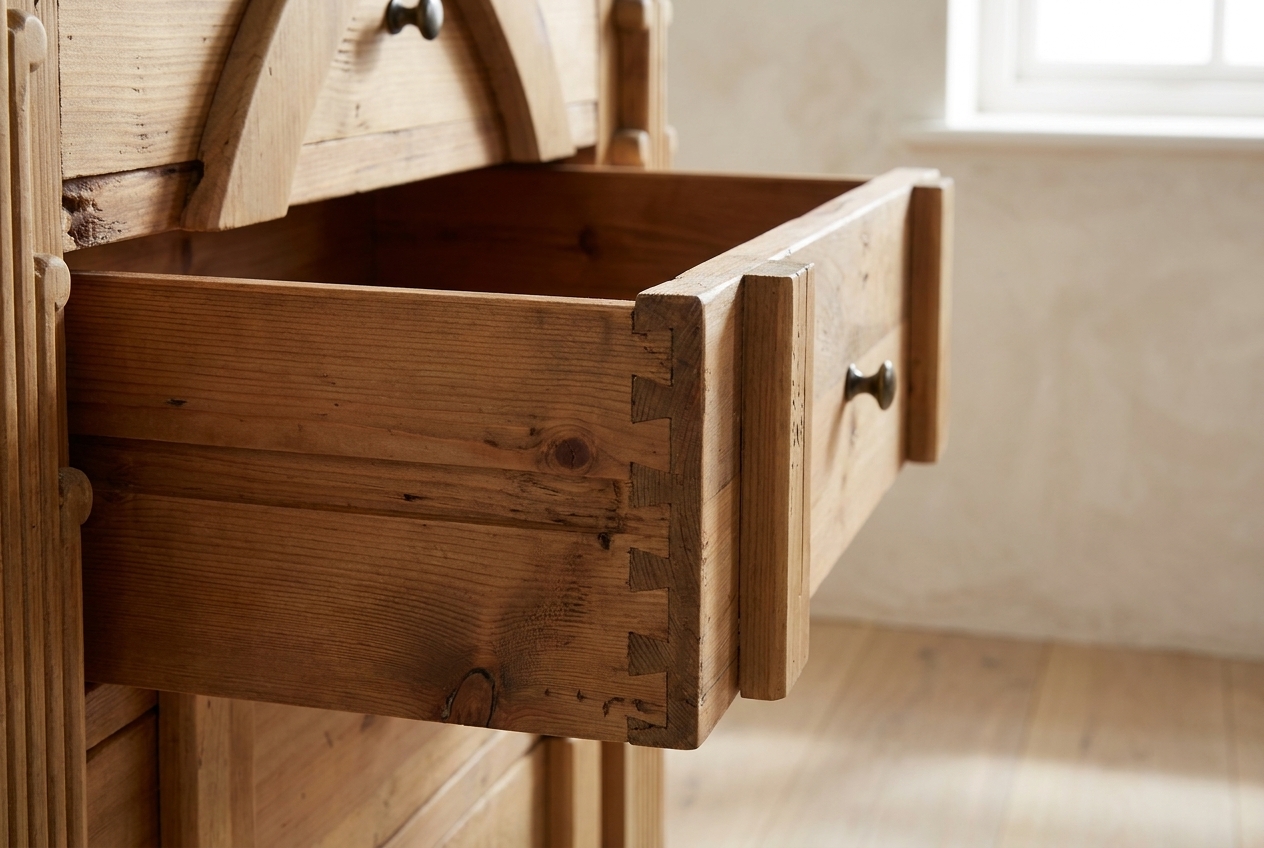
- Drawer boxes: ours are joined with English dovetails, which interlock the corners so they stay square over years of use. Budget pieces often staple or glue the corners, which let go over time.
- Interiors: ours are solid wood, not veneer over a pressed-board core, so there is no hidden MDF waiting to swell.
- Panels: tongue-and-groove construction lets them move slightly without splitting.
- Base: a traditional mitered base keeps the whole cabinet sitting true.
When you compare vanities, look past the surface and ask what the drawer box and the interior are made of. That answer tells you more than the price tag does.
The real cost over time
MDF wins the price comparison on the showroom floor and often loses it over the life of the bathroom. If an MDF vanity swells and has to be replaced, you pay twice, plus the labor and the disruption of swapping it out. A solid wood vanity costs more at the start, but it can be sanded, refinished, and kept for many years, and a reclaimed piece was built from wood that had already lasted a century before you bought it. There is an environmental side to that too, which we cover in sustainable bathroom renovation trends.
How to tell which one you are looking at
Online, the listing does not always make it obvious. A few ways to check:
- Read the materials line, not the headline. “Wood finish” or “wood look” usually means not solid wood. Look for “solid [species]” and a stated wood for the interior.
- Check the drawer box. Real dovetails and a solid-wood box are a strong sign. Stapled corners are a tell.
- Look at the weight and the price together. Solid hardwood is heavy and is rarely cheap. A large “wood” vanity at a very low price is almost always MDF or veneer.
- Ask. A maker who builds in solid wood will answer plainly what the cabinet and the drawers are made of. If you cannot get a straight answer, that is an answer.
The bottom line
If you want the lowest price today and the bathroom is well ventilated and lightly used, MDF can work for a while. If you want a vanity that handles real bathroom life and lasts, solid wood is the better buy, and reclaimed solid wood gives you that durability plus character no pressed panel can fake. Start with the single-sink vanities or browse all of our vanities, and the 30-inch Davidson is a good look at how a solid reclaimed piece is built.
Common questions about solid wood vs. MDF vanities
Is MDF or solid wood better for a bathroom vanity? For a bathroom, solid wood is the more durable choice because it handles humidity and can be refinished, while MDF swells and fails if water reaches its core. MDF costs less up front and can look good in a dry, well-ventilated bathroom, but solid wood lasts longer where there is steam and splashing.
How can I tell if a vanity is solid wood or MDF? Read the materials line rather than the headline. “Solid [species]” with a stated solid-wood interior is the real thing; “wood finish” or “wood look” usually means MDF or veneer. Check the drawer box for dovetail joints and solid-wood sides, and weigh the price against the size, since solid hardwood is heavy and rarely cheap.
Does MDF hold up in a bathroom? MDF can hold up for a while in a dry, well-ventilated bathroom, but its core absorbs water if the sealed surface is breached at an edge or around the sink, and once it swells it cannot be restored. That is why so many budget vanities fail first at the base and around the basin once water finds an unsealed edge.
Is reclaimed solid wood more stable than new wood? Reclaimed wood has already expanded and contracted through a century of seasons before it becomes a vanity, so it is unusually settled and stable. Built with proper joinery, it moves only slightly with bathroom humidity, the way a wood floor does.
Designed in High Point, NC and made to our specifications. Not sure which size or wood is right? You will not reach a call center. Call 336.471.0716 and you will reach Olivia directly, who can arrange a custom piece to your needs and stays with you all the way through delivery.