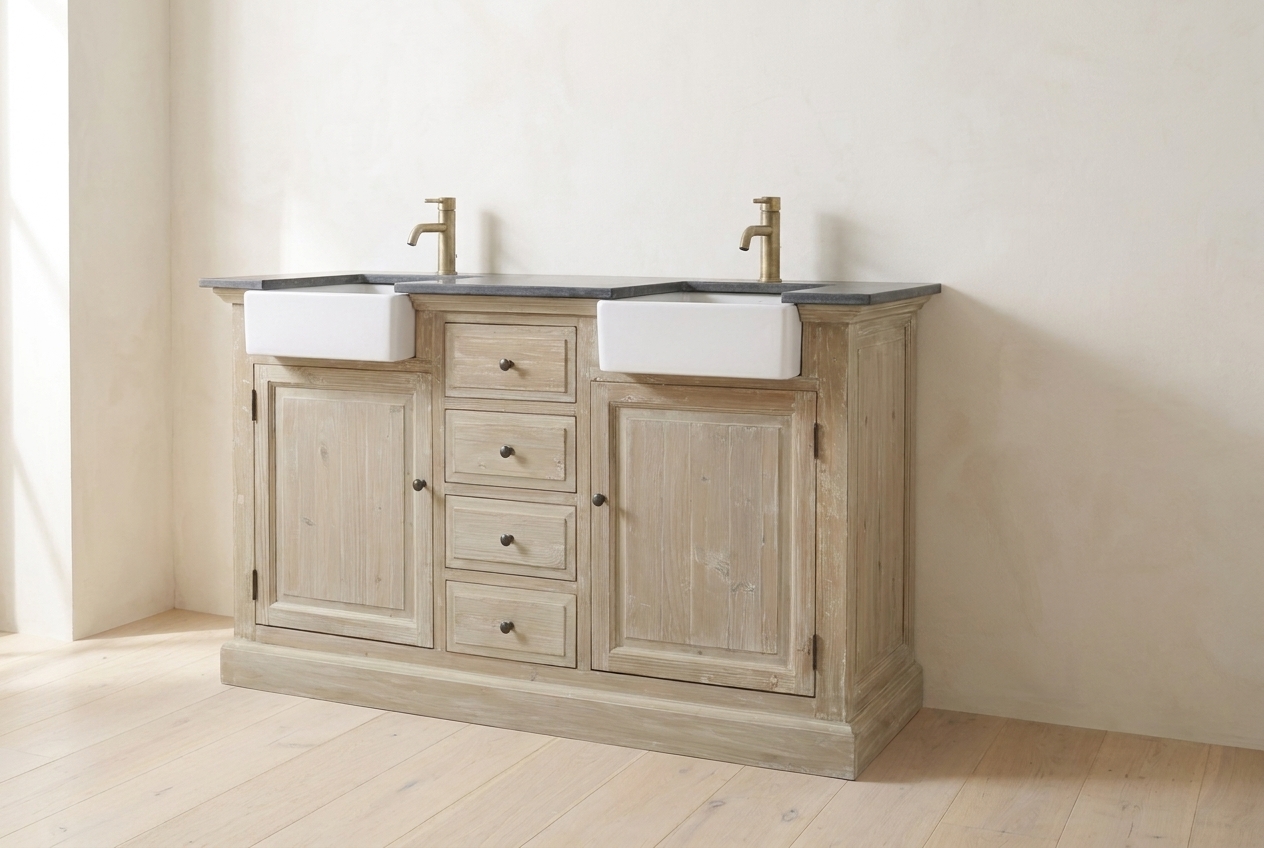

The choice between a single and double bathroom vanity comes down to three things: how wide your bathroom is, how many people share it regularly, and how it gets used in the morning. Get those three right and the answer is usually clear.
Jump to: Space · Shared Use · Morning Routine · Budget · Bottom Line · FAQ
| Single Sink | Double Sink | |
|---|---|---|
| Typical width | ~24″ to ~71″ | ~59″ to ~75″ |
| Best for | One user, guest baths, smaller spaces | Shared master baths, busy mornings |
| Counter space | One zone | Two zones |
| Storage | One cabinet run | Wider cabinet, more drawers |
| Starting price (our collection) | ~$550 | ~$1,200 |
| Bathroom size needed | More flexible | Needs more wall width |
How Much Space Do You Actually Have?
This is the question that decides it for most people, and it requires a tape measure before anything else.
A single-sink vanity can fit in a bathroom with as little as 36″ of clear wall, though most people find a 30″–36″ wide vanity more practical. The real constraint is clearance: most building codes require at least 15″ from the center of the sink to any wall or obstruction, and 21″ of clear floor space in front. In a narrow bathroom, those requirements often leave room for exactly one sink.
A double-sink vanity starts at around 59″ wide. To install one comfortably, you need enough wall for the vanity plus access on both ends for plumbing and trim. In most bathrooms, that means 65″ or more of usable wall. In a tight space, a wide double vanity will crowd the room.
Our single-sink collection runs from about 24″ to 71″ wide. Our double-sink collection starts at 59″ and goes to 75″. Measure your wall and your clearance before you start browsing, and you’ll save yourself a frustrating return.
How Many People Share This Bathroom?
A single sink works fine for one person, regardless of how complicated their morning routine is. Two people who need the sink at the same time is where a single sink starts to be a problem: someone is waiting, someone is rushing, and the counter ends up crowded with two sets of everything.
In a master bath shared by two adults, a double-sink vanity solves that friction. Two sinks, two counter zones, two people on their own schedule. In that context it’s a practical answer to a logistics problem that shows up every morning, not an indulgence.
In a guest bath, a hall bathroom, or a bathroom used by one person, a single sink is the sensible call. The extra cost and counter space of a double don’t serve anyone.
What a Double Sink Actually Changes
Beyond two sinks, a double vanity adds meaningful counter space and storage over a single-sink cabinet. If two people are storing their things in one bathroom, that extra drawer space solves a real problem.
For more on how a piece like this holds up in a real, shared bathroom environment, our post on incorporating vintage into a modern bathroom covers the design side of living with reclaimed wood day to day.
The trade-off is wall space. A 59″ vanity commits a significant portion of most bathroom walls. In a smaller room, a well-proportioned single-sink vanity will feel more comfortable and leave the bathroom usable. A double that crowds the space doesn’t serve anyone either.
What’s the Price Difference?
Double-sink vanities cost more than single-sink vanities: more material, more construction, wider stone top, two sinks instead of one.
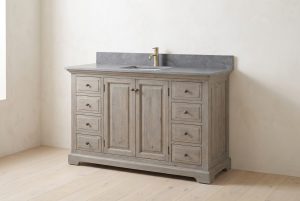
In our collection, single-sink pieces start at around $550. Double-sink vanities start at around $1,200. As a concrete example: the 59″ Maxton is $1,200: reclaimed pine in a wash finish, with a slate grey stone top, at 59W × 20D × 36H. It’s also available as a base only if you have an existing top or want to source your own stone.
That price difference reflects real differences in material and construction, not a premium for two holes in the countertop. For the bathroom it’s designed for, a shared master bath with two regular users, the cost is usually worth it. For a bathroom one person uses, the extra spend doesn’t pay off.
Bottom Line
Choose single if:
- Your bathroom wall is under 60″ wide
- One person uses the bathroom regularly
- It’s a guest bath, hall bath, or secondary bathroom
- Budget is the main constraint
Choose double if:
- Two adults share the bathroom daily
- You have 60″–65″ of usable wall or more
- It’s a primary master bath
- You want more counter space and storage for two people
If you’re planning to sell in the next few years, a double-sink master bath is a meaningful selling point. If this is a practical bathroom used by one person, a single sink is the honest answer, and there’s a lot of room to choose a piece with real character.
Browse our single-sink vanities or double-sink vanities. Each one is designed in High Point, NC and made to our specifications from solid reclaimed pine. Finish options vary by piece, so check the product page for what is offered on the vanity you like. For sizing and logistics, the delivery information has what you need before you commit.
Frequently Asked Questions
What is the standard width for a double-sink vanity? Most double-sink vanities run between 59″ and 72″ wide, though what’s available varies by maker. Our double-sink collection starts at 59″ and goes to 75″. The right width is the widest piece that fits your wall with plumbing clearance on each side. Measure the wall, not just the opening.
Do you need a double sink in a master bathroom? Only if two people share it regularly. In a shared master bath, two sinks remove real daily friction. In a master bath used by one person, a well-chosen single-sink vanity is a better use of space and budget.
Can one person use a double-sink vanity? Yes. Many people do. One sink stays capped, and the extra counter and drawer space is genuinely useful. It’s worth it only if the bathroom has the wall space to absorb a wider vanity without feeling cramped.
What’s the difference between “base only” and “complete unit”? Some vanities, including the Maxton, are available in two configurations. The complete unit includes the stone top and sinks; the base-only option is for buyers who have an existing top or want to source their own. Check the product page for which options are offered on the piece you’re considering.
How do I know if my bathroom can fit a double-sink vanity? Measure the wall from corner to corner, then subtract space for any doors, windows, or trim. A 59″ vanity needs at least 59″ of clear wall, plus access for plumbing on each end. If you’re unsure about rough-in placement, a plumber can confirm before you order.
Designed in High Point, NC and made to our specifications. Questions about wood, finish, fit, or shipping? Call 336.471.0716 and you’ll reach Olivia directly, who personally handles everything from your first question to your delivery.