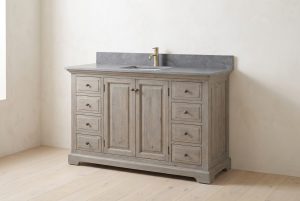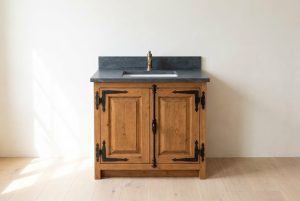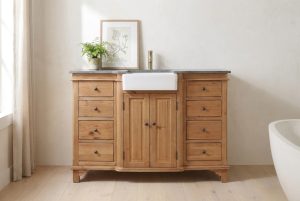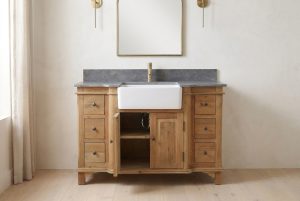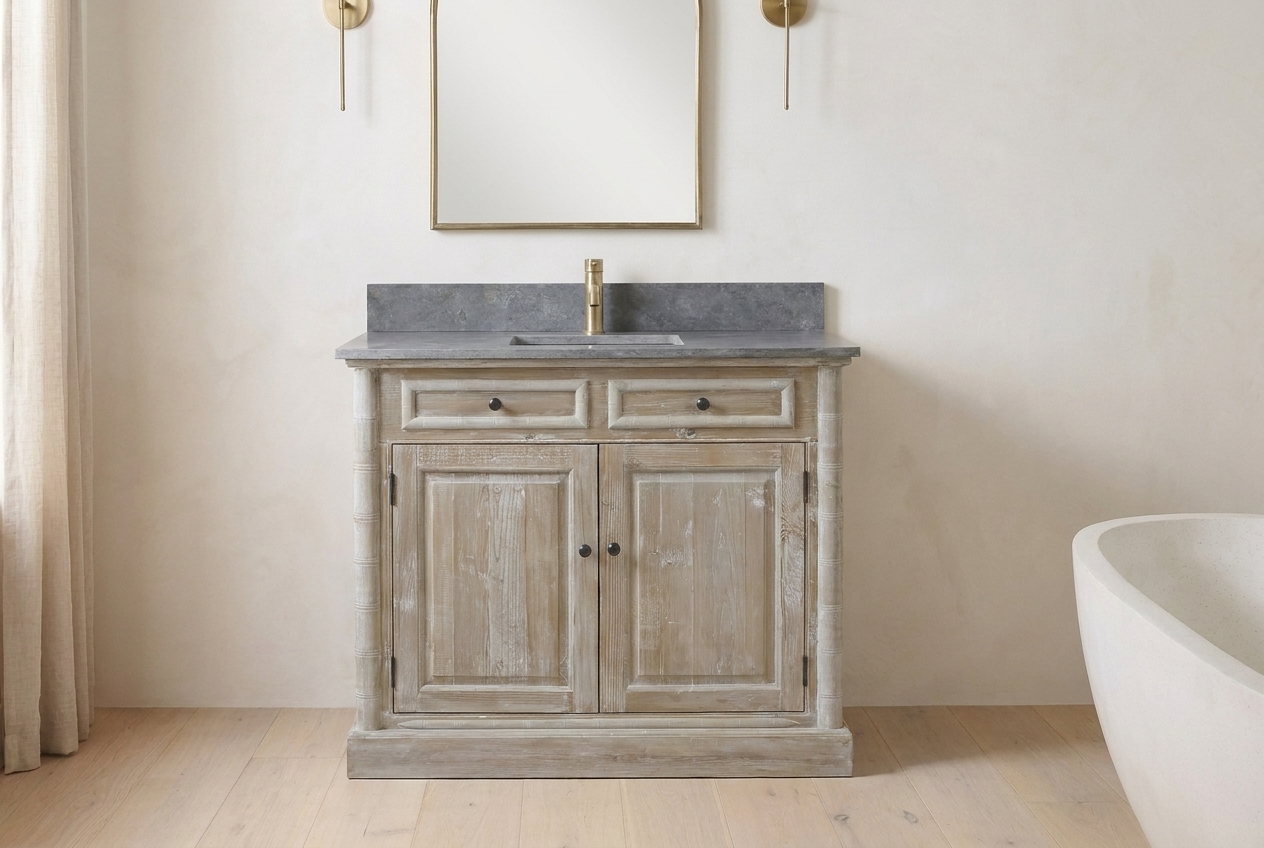

Yes, a reclaimed wood vanity holds up in a bathroom, as long as it is built from solid wood, joined properly, and finished for the room it lives in. The fear most people have, that the wood will swell, warp, and leave the drawers stuck shut by next winter, comes from a real problem. It is just usually the wrong material taking the blame. Here is the honest version, from the people who design these pieces and stand behind every one of them.
The real worry: will it swell, warp, or stick?
When someone asks us whether wood survives a bathroom, this is almost always what they mean: the drawers swelling shut in August, the doors no longer closing flush, a top that cups after a year of steam. It is a fair thing to ask. Wood moves. It takes on a little moisture when the air is humid and gives it back when the air is dry, and that movement is what makes a poorly built cabinet bind.
The thing is, most of the horror stories come from cabinets that were never solid wood to begin with. Particleboard and MDF do not just move, they fail. They drink up water at a cut edge, swell, and crumble, and once that happens there is no fixing it. People live through that with a big-box vanity, understandably swear off “wood” in a bathroom, and never realize the material that let them down was sawdust and glue pressed into a panel.
Solid, naturally aged wood behaves differently. It moves a little with the seasons, the way a wood floor or an old farmhouse door does, and a cabinet built to expect that movement takes it in stride.
Why reclaimed wood is a good fit for a humid room
Reclaimed wood has one quiet advantage here: it has already done its moving. Wood with this kind of history has spent decades expanding and contracting through summers and winters, drying out and settling long before it ever becomes a vanity. It is stable in a way freshly milled lumber simply is not yet.
It also carries its history on the surface. Knots, nail holes, saw marks, and color variation are part of the wood, not flaws in it. In a bathroom, that character earns its keep, because a little water spotting or a faint ring from a glass reads as patina on a board that already has a hundred years of marks, not as damage on something that was supposed to look factory-perfect. Reclaimed wood ages gracefully because it is already aged.
Our vanities are made of solid pine, chosen for its character and warmth in a room with a shower in it. You can see the full range across our vanities.
How a vanity is built to handle a bathroom
A vanity survives a bathroom because of how it is put together, not because of a coat of magic. The construction is where the durability lives, and ours are built the traditional way:
- Solid-wood drawer interiors, not veneer over particleboard. The part of the cabinet most exposed to damp is built from real wood through and through, so there is no pressed-board core waiting to swell.
- English dovetail drawers. Dovetails interlock the drawer corners so they hold together and stay square through seasonal movement, instead of relying on staples or glue that let go over time.
- Tongue-and-groove construction. Panels are joined so they can move slightly without splitting or forcing a joint apart.
- Traditional mitered bases. A solid, properly joined base keeps the whole piece sitting true on your floor.
None of that is decorative. It is the difference between a cabinet that shrugs off a few humid months and one that binds up.
The finish is what meets the water
The wood and the joinery handle movement. The finish handles the day-to-day: the splashes, the steam, the toothpaste spray, the wet hands. Our three standard finishes are a protective layer over the wood, not just a color.
- Natural is our rich medium-brown finish.
- Wash gives a driftwood look, with gray tones.
- Waxed is a matte sheen that highlights the wood’s age marks.
Each vanity is listed in the finish that suits it, so check the product page of the piece you love for its exact finish. What matters for a bathroom is that the piece is finished, and that you treat the finish as the working surface it is. Wipe up standing water rather than letting it sit, especially near the sink, and the finish does its job for a long time. We will always tell you that plainly rather than promise a vanity is waterproof, because no real wood piece is, and anyone who says otherwise is selling you something. A reclaimed wood vanity is not fragile. It just rewards a little common sense, the same way a good wood table or floor does.
If you want to see how reclaimed materials fit a modern, lower-impact bathroom more broadly, we wrote about that in sustainable bathroom renovation trends.
So, is it the right choice for your bathroom?
For most bathrooms, yes. A solid, reclaimed-wood vanity, built with real joinery and a proper finish, will outlast a particleboard unit by years and look better the whole time it is doing it. The places to think twice are the genuinely extreme ones: a small, unventilated bathroom where steam has nowhere to go and sits on every surface, or a setup where water pools and never gets wiped. Those conditions are hard on any material, wood included. A working exhaust fan and a quick wipe of standing water cover almost everyone.
If you are weighing a single-sink piece for a main or guest bath, the single-sink vanities are the place to start, and the 30-inch Davidson is a good example of the build in a size that fits most rooms. You can also read our story if you want to know the people who design these pieces and stand behind them.
Common questions about reclaimed wood vanities in bathrooms
Will a reclaimed wood vanity warp in a humid bathroom?
A solid, reclaimed-wood vanity built with real joinery moves only slightly with the seasons, the way a wood floor does, and a cabinet built to expect that movement does not bind or warp under normal bathroom humidity. The warping and swelling people fear usually comes from particleboard or MDF, which absorbs water at the edges and fails. Reclaimed wood has already settled over a century of expanding and contracting, so it is more stable than freshly milled lumber.
Does a wood vanity need an exhaust fan?
A working exhaust fan helps any bathroom, wood vanity or not, because it clears the steam that would otherwise sit on every surface. You do not need anything special beyond that. Good ventilation plus wiping up standing water near the sink covers almost every bathroom.
Is reclaimed pine too soft for a bathroom vanity?
Pine is a softer wood than some hardwoods, so it can take a dent more easily, but that is a different question from whether it survives moisture. Our reclaimed pine has aged and settled over a hundred years, it is finished as a working surface, and on a vanity those small marks read as character rather than damage, which is exactly the lived-in look most people are after in a reclaimed piece.
Designed in High Point, NC and made to our specifications. Questions about wood, finish, or fit for your bathroom? Call 336.471.0716 and you will reach Olivia directly, who personally handles everything from your first question to your delivery.